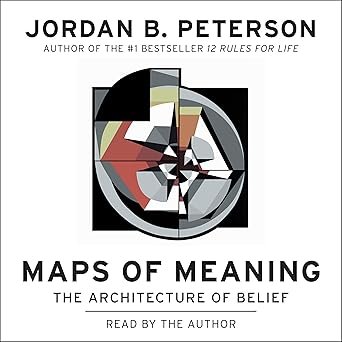
Maps of Meaning: The Architecture of Belief is Jordan B. Peterson’s groundbreaking exploration of how human beings construct meaning through stories, myths, and belief systems. Long before the publication of 12 Rules for Life, this ambitious work laid the intellectual foundation for Peterson’s thinking on responsibility, morality, and the psychological struggle between order and chaos.
The book begins with a compelling question: why do myths, religious narratives, and symbolic stories from vastly different cultures and historical periods share strikingly similar structures? Peterson argues that these similarities are not accidental. Instead, they arise from fundamental patterns in human cognition and neurobiology that shape how people understand the world and their place within it.
Drawing from neuropsychology, cognitive science, evolutionary biology, and depth psychology, Peterson integrates the ideas of Carl Jung and Sigmund Freud with modern neuroscience. He proposes that myths and rituals encode practical knowledge about survival, social cooperation, and moral behavior. These stories function as maps—guides that help individuals navigate uncertainty, threat, and transformation.
Central to the book is the concept of order and chaos. Order represents stability, tradition, and known structures, while chaos symbolizes uncertainty, novelty, and the unknown. Peterson explains how meaning emerges when individuals voluntarily confront chaos, integrate new experiences, and transform themselves responsibly. Mythological heroes, religious figures, and symbolic narratives illustrate this psychological process across civilizations.
Unlike purely academic texts, Maps of Meaning bridges scientific analysis with philosophical and spiritual inquiry. Peterson examines religious symbolism, biblical stories, ancient myths, and cultural rituals, revealing how they mirror deep psychological truths. He also discusses the dangers of ideological rigidity and totalitarian thinking, showing how distorted belief systems can arise when individuals or societies deny complexity and moral responsibility.
The book challenges the modern tendency to dismiss myths and religious traditions as outdated or irrational. Instead, Peterson argues that these narratives persist because they address fundamental human concerns—suffering, mortality, morality, and purpose. By understanding their psychological foundations, modern readers can extract wisdom without abandoning critical thinking.
Though demanding and intellectually dense, Maps of Meaning rewards readers with profound insights into the human condition. It is ideal for those interested in psychology, philosophy, religion, cultural studies, and personal development. For readers seeking to understand how beliefs shape behavior and why meaning is essential for a stable and purposeful life, this book remains a powerful and influential work.








 Maps of Meaning: The Architecture of Belief































Reviews
There are no reviews yet